
Writing the Script for Let’s Talk

Image result for script writer

final let’s talk script

parent manual

As part of my role and responsibilities for creating Let’s Talk, I had the task of developing the Script and managing the content throughout the app. This involved writing the dialogue for the chapters with the information about the changes boys and girls experience during Puberty, How Babies are Made, and Consent. I also brainstormed ideas for the animations which the characters feature in to create a scenario a young person may find themselves in such as a boy’s voice breaking, a girls first period and explaining the different body shapes boys and girls have. I wrote the dialogue for these animations which I then gave to the lead animator within the group who could use this for reference when illustrating the backgrounds, characters and animating the scenes. 

To begin the process of writing the script for Let’s Talk I began researching methods on storytelling, writing for animation and writing for multimedia and visual media. A book by Michael D. Korolenko entitled ‘Writing for Multimedia: A Guide and Sourcebook for the Digital Writer’ was very helpful in explaining the steps involved in writing a script. 

“The Writer must deal with six considerations during preproduction: The Idea, The Audience, Brainstorming, Goals and Objectives, The Treatment and the Content Outline.” (Korolenko, 1997)

The idea: The idea is the first step of the project and deals with what the project will do and gives the project a “terminal object” meaning what the users will be able to do when the course is completed. In my case it is a project which provides children with the information they need as they experience puberty in a modern, story-based  and interactive way.

The Audience: Finding the target audience for any multimedia project is the main focus when it comes to the design aspect. We need to know the knowledge our users have when creating a learning program such as Let’s Talk. Carrying out the Assure Model was helpful in doing this as it gave an insight to who the learners are. The Target audience will be children ages 8-14. It is important to understand who we are designing and writing for so the users can get the most out of their experience with the application. 

Brainstorming: “Brainstorming, sometimes called “free association”, is when one approaches a subject from every conceivable angle, writing down ideas as they come. During an interactive multimedia project, brainstorming often occurs in a group of writers, designers and directors all working together to think up ideas and jot them down” (Korolenko, 1997) I used the brainstorming technique at the beginning of writing the content to help narrow down what topics needed to be covered for both boys and girls. I used this method again when coming up with ideas for storylines in the animation which the characters would experience such as buying your first bra. 

Goals and Objectives: Goals and objectives are knowing what you want the user to learn and what the message of the project is. The goal of Let’s talk is children will have a safe interactive and fun tool where they can learn about Puberty and Sex education. The objectives of Let’s Talk which will be the steps users must do to achieve the goal will be in the form of quizzes and animations. Using the “CABD” format: Conditions, Audience, Behaviour and Degree, the objectives for Let’s Talk are:

  1. C = Conditions: “Chapter about Girls Body Changes is read..”
  2. A = Audience: “the child”
  3. B = Behavior: “will be able to label the parts of the female anatomy”
  4. D = Degree: “100% correct”

The Treatment: “The treatment is the written summary of what one wants the final multimedia product to look like and how the user will interact with the product” (Korolenko, 1997) The treatment determines the “flavour” of the program whether it is selling something or is funny, serious or informative. Getting the treatment done early is important as it is the guide for the script writer and how the programs navigation will work. Using storyboards can be useful in making the treatment visual. 

The Content Outline: “The Content outline is a specific list of what will actually be included in the project” (Korolenko, 1997)  Doing this will ensure that all group members are on the same page and are aware of what is needed for the application.

When researching material online and in books I accumulated the information needed for the app and started writing the script for each chapter. In order to learn about the topics of Puberty and ensure I was using the correct terminology I watched Youtube videos such as WellCast (WellCast, 2014) and AMAZE (AMAZE Org, 2016) which helped with explaining the various chapters such as periods, erections, hygiene, how babies are made and consent. 

My aim was to write a script which was appropriate for young people and wasn’t too complicated like a biology textbook. I also kept this in mind when writing the dialogue for the characters. The characters speech needed to sound natural and believable in what they were saying as well as being suitable for what was on screen. Some characteristics to take into consideration when writing the dialogue of the characters are Age, gender and education. The age of the users will be between 8-14 so the characters needed to sounds relatable to that age group. 

Gaining an insight into how Dialogue plays an important factor in storytelling helped me to understand essence of good dialogue. It depends on may factors such as who the characters are, their relationships, the situation they are in, the length of the script as well as the age of the target audience. I learned the difference between different types of dialogue that can be used such as “Real Talk” and “Reel Talk”. “Real Talk” is more natural, like how we sound in our every day lives We talk with “uhhs” and “ahms” during pauses and use jargon and colloquialisms.

“Emotions change dialogue. Keep it simple; less is more. The words must always be easily understandable and clear to everyone. You might want to repeat important story points, especially for preschoolers, but repeat with a twist” (Wright, 2013)

Repeating that changes which happen during puberty are normal was an important lesson to repeat for the users of Let’s Talk. I wanted to make it clear in the animations that when something happened for the first time that the characters were reassured that this was normal. I also wanted the script for the information in the chapters to reiterate this point also. In doing so, children will not have any doubts about what is happening to their bodies at such an awkward time in their lives.

References

AMAZE Org (2016). Top Signs Boys are in Puberty. Available at: https://www.youtube.com/watch?v=onggxBVl4qw&t=3s [Accessed 13 Apr. 2019].

Korolenko, M. (1997). Writing for multimedia. Wadsworth Publishing Company, pp.110,111,113,114,115,116,117.

WellCast (2014). What is Puberty? Decoding Puberty in Girls. Available at: https://www.youtube.com/watch?v=Tr8ZSH3eghs [Accessed 12 Apr. 2019].

Wright, J. (2013). Animation Writing and Development. Burlington: Focal Press, pp.196,197.

Teaching Puberty in Ireland Today

In Ireland, relationships and sexuality education (RSE) is a module within Social Personal and Health Education, which has, since 2003, been a compulsory part of the Junior Cycle (students aged 12–16) curriculum. This is where students receive the majority of their Sex Education. The current curriculum has been in place since 1999 and is in dire need of an update. Legislation allows schools in Ireland to influence the ethos of how Sex education is being taught. As most schools in Ireland are run by the Catholic Church, there is a lack of teaching of topic with relation to LGBTQ relationships, gender identity, consent and sexual orientation. (Kelly, 2019)

For Primary schools in Ireland it is not compulsory for them to teach RSE and when we look at the statistics that show children are developing much faster than they did a century ago, it creates an issue. Some Girls are getting their periods before they are getting an education about them. There is no standardised SRE curriculum for primary schools, therefore the quality of a typical primary school child’s education about puberty is hard to predict.

“Currently, children are taught about puberty when aged about 11. Yet, the onset of puberty – which used to occur at 17 in the 17th century, and 15 a century ago – has now dropped to nine or 10.”  (Kirk, 2017)

Image result for busy bodies

The HSE provide Primary schools with a programme, called ‘Busy Bodies’. This is usually introduced around 5th and 6th class. The programme entails a booklet and a DVD dealing with all of the physical and emotional changes that children may experience during puberty. The main aim of the resource is to reassure children that puberty is a normal part of growing up and the booklet is designed to be used after the pupils have watched the ‘Busy Bodies’ DVD.

Unfortunately, there are some issues with the content in the booklet. The book is very limited to what Consent is. It explains consent as the age that you are legally old enough to have sex. In the booklet it states “It is not a good thing for people to have sex before they are grown up and ready for it. And for this reason, the law protects you from feeling any pressure about this, by making it illegal for anyone to have sex with a young person under 17. This means that you are not legally old enough to agree to (or consent to) having sex until you are at least 17.” (Busy Bodies, 2008).

It is implying that consent only happens when you are under the age of 17 when in fact consent is something we experience at every age with any person, not someone who is just “older”. It can be something as little as giving someone permission to hold your hand or touch your face. Every child must know they are entitled to their own say when it comes to people touching their bodies, if they feel uncomfortable they must know they can speak up. 

Another issue within Busy Bodies is the difference in how the changes for boys compared to girls is portrayed. The booklet describes erections as something that happens when boys become sexually excited resulting in the penis becoming harder and bigger. But when describing what the clitoris is for girls, there is no mention of “sexual excitement” or how the clitoris becomes larger, the same as a penis when girls are sexually excited. The booklet only states the clitoris as a “Fleshy bump near the urethra”. It describes erections for girls are easier to hide because they are “internal”. This is in no way a clear explanation to what happens to girls bodies. It’s as if girls need to feel ashamed of feeling any sexual desire. To make the idea of puberty even worse for girls the booklet says the one thing girls can be excited for is “Coping with Periods” Boys can get excited which leads to sexual feelings, but girls get to be excited about period pain? When Talking about sex, there is no mention of consent or sexual feelings all that’s needed for sex to take place is for a man’s penis to be erect and then for him to simply put it into a woman’s vagina.

“There is a hidden bias in this booklet that is sexist. Men can be sexual beings for pleasure, and sex happens when a man is actively sexually stimulated. Women are ‘excited’ to be fertile (get their periods), and to have sex, no physical change is apparently needed in their body.” (Woods, 2018)

Although the booklet provides the children with information on the changes to the body and sex with explaining how babies are made, it can not be the sole responsibility of the school to ensure children are getting the full education they need with regards to their bodies. Children should feel comfortable coming home to ask questions and get the answers they desire with someone they trust such as a parent or older sibling according to their values and beliefs. 

There is a stigma in Irish homes when openly talking about Sex and it seems to be the Irish mentality that the school will take care of it. But if some schools aren’t talking about it until the Junior Cycle at the ages of 12-16, this leaves it too late for young people if there are no conversations on the topic at home.  All it takes is one episode of The Simpsons for a child to see that Sex in media is clearly visible and easily accessible. Tv, internet and magazines have been increasingly sexualised over the past decade. Even with this change in our society it still leaves parents cringing at the thought of sitting their child down and talking about Puberty and Sex. It is not fair on young people today who are not receiving the information needed to feel comfortable and confident in their bodies.

“Being unable to fully comprehend the hormonal and emotional changes that are part and parcel of puberty, or what it can mean for them on a reproductive level, can have profound repercussions. It is perhaps no surprise that early puberty is linked to emotional and behavioural problems, as well as significant health issues such as an increased risk of diabetes, heart disease and other cardiovascular diseases, as well as cancer, later in life.” (Kirk, 2017)

It is alarming to hear the consequences of not getting a proper education on Puberty and Sex. With the help of schools and parents, the development of an app such as Let’s Talk can be a step in the right direction for this problem. 


References 

Age Guide for Content

To form the basis of what each age group is recommend to know I looked at articles which gave a review of an age by age guide to Sex Education based on child sexual development and keeping children healthy and safe.

For Babies, this would be ages 0-24 months, they are taught the names of their body parts. This includes the Penis and Vulva. They are told it is okay to touch their body parts but only in private and never in public as it is inappropriate. Knowing the difference between boys and girls body parts and what each part does too.

“The end goal is for your child to be comfortable with their whole body and to see all parts as being equal (with no shame).”

During Early Childhood, ages 2-5 years old, they learn about correct names for body parts, the similarities between boys and girls, such as nipples/bottoms/noses/hands. They are told its okay to be different and that our bodies can tell us what we are feeling like being tired, hungry or sad.

Privacy is introduced with learning things such as, not showing your private parts in public or when people outside of family are at home. Other people’s privacy must be respected like when going to the toilet you must knock if the door is shut. Conversations about bodies and for at home in private with their parents. They must know touching themselves is okay but that there is a time and place for it.

 To explain how the baby comes out,

Body ownership and touching is introduced by explaining they have the right to

Middle Childhood, ages 5-8 years old start to know what words to use for both boys and girls body parts and have some knowledge about internal reproductive organs. They learn t

They are given and introduction to Puberty and told their bodies will change as they get older. Sexual Intercourse is spoken about by explaining

Sexual Behaviour is covered also, including masturbation and

Late Childhood, ages 9-12 years old, is where all the above topics are spoken about but with more detail. In relation to Puberty they must know w

In relation to Sexual Behaviour, b

Knowing what the recommended topics to talk to your child about at each stage of their life can be helpful when they start asking questions or when you feel like they should know more about their body. This guide can also be taken into account when using Let’s Talk to talk to their child about Puberty and Sex. Having an app may take some of the pressure off the parent to get everything perfect. They can chose specific chapters they feel is necessary in the the app that suits the child’s current age.


References

Hakanson, C. (2016). My Kid Needs to Know What? An Age By Age Guide to Sex Education – And What to Do! (by Cath Hakanson) –. [online] Heysigmund.com. Available at: https://www.heysigmund.com/kid-needs-know-age-age-guide-sex-education/ [Accessed 28 Mar. 2019].


Principles of Let’s Talk

The main principles of Let’s Talk include teaching Children about Puberty and Sex Education in a controlled, safe and interactive manner as well as providing correct information that children and teenagers need in preparation for the changes that their body will go through physically and emotionally.  In order to provide these principles throughout the app, I aimed to create information that was, accessible, engaging, and comfortable to deliver for the parent and child.

A problem that became apparent in my research about how Puberty is being taught in schools was the there is a strong focus on the act of  safe Sex. While this is important in the education of young people this is not the same as the teaching of our bodies.

“Sex education is an important piece of that [puberty], but we must keep in mind a simple fact: that sex happens from the context of a body, but the body exists independently of sex.” (Causbie, 2016)

When we think about where we received the core information about our bodily changes and functions, the majority of the time, it was paired with the topic of safe sex. Teaching children to be more “body literate” will guide them to a clearer understanding of what an adult body is rather than what it can do in relation to sex. Furthermore, it will leave them feeling more confident and more in control of their bodies.

“We should also have body education, teaching young people about their hormones and cycles, well before sex is even in the picture. With a deeper bodily knowledge they can become more responsible, educated, and empowered adults.” Causbie, K. (2016)

With Body Literacy in mind, the inclusion of body autonomy was a chapter which was an important one to include in Let’s Talk. Ensuring the young users of the app had the knowledge to label parts of their bodies and knew what each part did. By incorporating this into the App, Children can get more out of their education in Puberty. Especially in regards to girls and their menstrual cycles, which can be complicated to understand, and boys dealing with their first erection. Puberty is a difficult time, giving children the information needed about their body, makes the matter less overwhelming and easier to understand.

To create an app that acted as a tool for a safe education in Puberty and Sex Education which is comfortable to deliver, the help and co-operation of parents is needed. Even if a child is taught about sex education at school in informative and high-quality lessons, it’s still a good idea to talk to them about growing up and that Puberty happens to everyone. It’s important that they feel they can talk to a parent and ask questions during such a confusing and challenging time in their lives. – 3

Including a digital PDF manual for parents with the download of Let’s Talk, means parents can be prepared for what the app features and how best to approach the conversation with their child. Some helpful tips suggested by PlannedParentHood.com and ParentInfo.org state that “little and often is best“. Avoid sitting in a formal situation and having one big sex talk. Another tip is to “Listen hard and talk soft“, try not to lecture you child and listen to what they’re trying to say as this lets them open up and feel more comfortable asking for advice. Sex talks need to be engaged and have real communication to work. Remind them that “Different is normal”, tell them it is normal for breasts, penises, nipples, labia, testicles, and clitorises to come in many different shapes, sizes, and colours. This will make them feel less self conscious about their bodies and avoid comparing them to celebrities and other people they see. (Plannedparenthood.org, n.d.)

To ensure the content for Let’s Talk is engaging, the app must feature feedback to the tasks that are required, such as in a game, puzzle or quiz. Giving the child praise for completing a task will motivate them and make them feel joy for doing so.

When sticking closely to these main principles for Let’s Talk which tackle some existing problems in other forms of Education in Puberty and Sex, Let’s Talk will serve a purpose in giving children a safe, interactive and modern education.

IMG_1833.JPG


References

  1. Causbie, K. (2016). The Importance of Body Literacy in Puberty | Kindara Blog. [online] Kindara.com. Available at: https://www.kindara.com/blog/the-importance-of-body-literacy-in-puberty [Accessed 14 Mar. 2019].
  2. Doyle, L. (2018). When to talk to your child about puberty (or will school take care of it)?. [online] ParentInfo. Available at: https://parentinfo.org/article/when-to-talk-to-your-child-about-puberty-or-will-school-take-care-of-it [Accessed 16 Mar. 2019].
  3. Plannedparenthood.org. (n.d.). What should I teach my high school-aged teen about their body?. [online] Available at: https://www.plannedparenthood.org/learn/parents/high-school/what-should-i-teach-my-high-school-aged-teen-about-their-body [Accessed 16 Mar. 2019].

Sex Education Books for Kids

Books are considered the main competitor to the Let’s Talk app. There are numerous books on the market which give children an understanding of Puberty and Sex education. I want to review a number of them and speak about how they managed to stand out at being some the best. Analysing these books should give us an insight into how to tackle these topics in our app and what the professionals are doing to engage children into learning about Sex education.

Many parents use books as a way of introducing their child to sex as it is a helpful way to start the conversation, that may be an awkward topic for some. Using a book which provides the words/script/context is a great place to start as it eases off the pressure to have to know everything as a parent. They also provide some great age-appropriate content or words to use. And It is known that there are some amazing benefits to reading aloud with your child. (Hakanson, 2019)

22889878

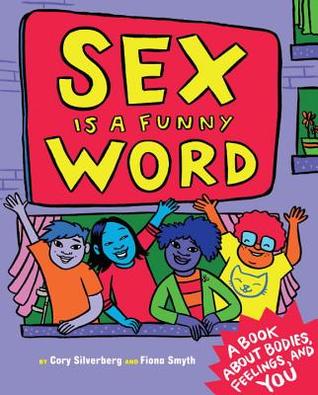
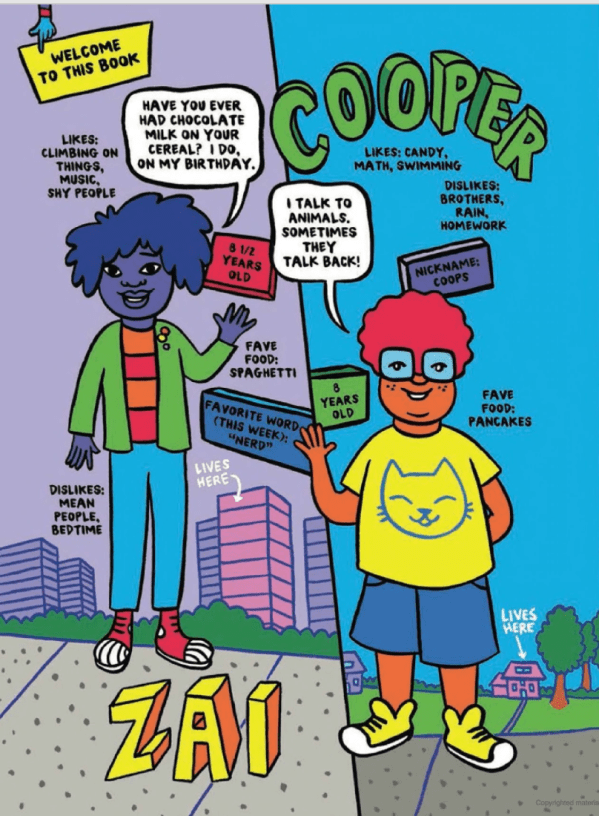
The first book I want to look at is “Sex is a Funny Word”  by Cory Silverberg. This book is described as a comic book for kids that includes children and families of all makeups, orientations, and gender identities, Sex Is a Funny Word is an essential resource about bodies, gender, and sexuality for children ages 8 to 10 as well as their parents and caregivers. The book features four relatable kids who take the reader through all the topics covered in the book with humor and a little bit of sass. The book begins with an introduction of each of the characters with some quirky facts about them such as their favourite food, their likes and dislikes, The diversity of the characters in the book is something that sets this particular book apart from the others. This is an aspect Let’s Talk will focus heavily on also.

The comic is thought to be the new and reimagined “sex talk” for the twenty first century. The book is a great opportunity for adults to convey their values and beliefs to their children while providing information about boundaries, safety, and joy at the same  time (Silverberg, C. and Smyth, F, 2016). While doing my research of this book and what people liked about it, I found that a key factor to the success of “sex is a funny word” is the balance of information. Puberty and Sex is a heavy topic with heaps of information.

Screen Shot 2019-03-03 at 22.09.24.pngIt can be a lot for even adults to wrap their head around. However, Silverberg achieves to provide the right amount of information without overloading a large amount of technical and complicated biology. With regards to the illustration, the illustrations of genitalia are cartoony, but extremely thorough enough to show the diversity of what our parts look like and what they can do without shame or judgment.
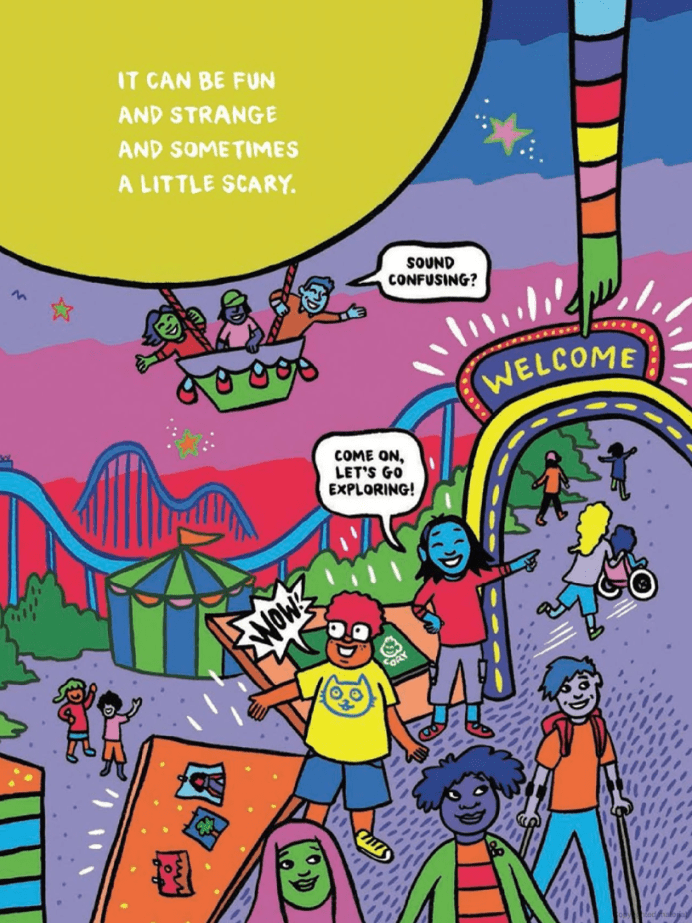
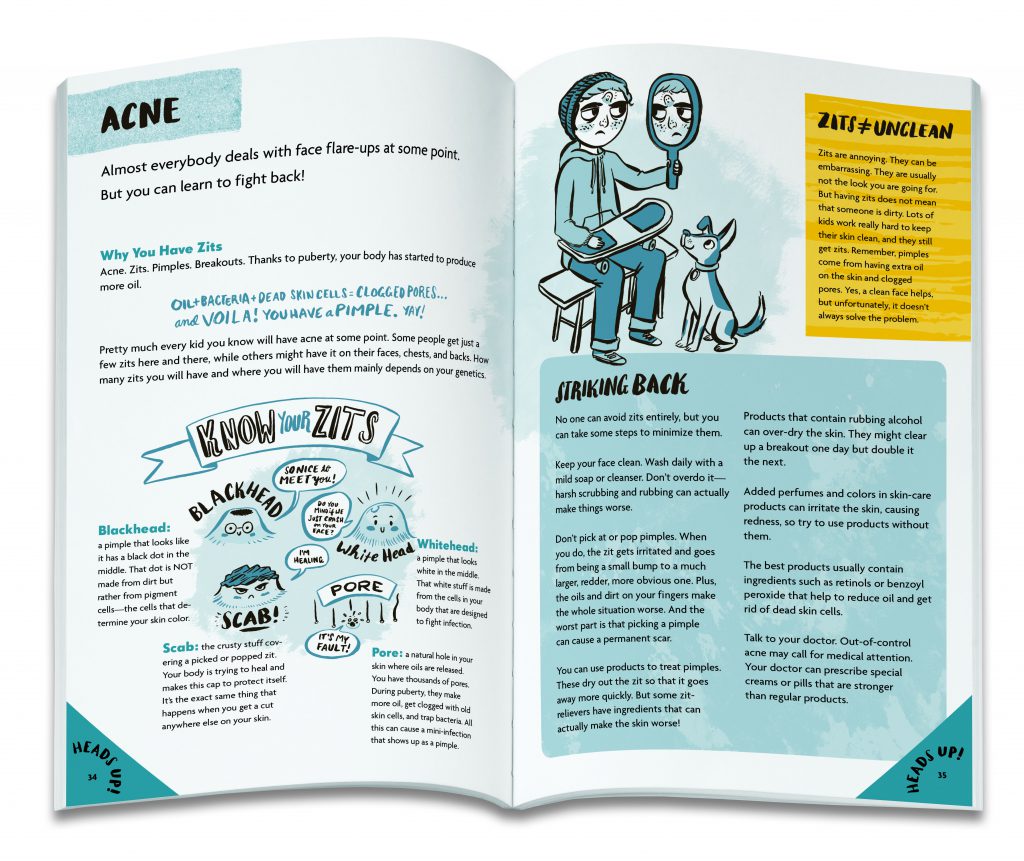
Each page of the comic is so enticing and engaging and as a child, these types of illustrations are usually fun to look at. There are elements of interaction with the reader too, such as asking questions at the end of each chapter which encourages the reader to answer or talk to a person they trust about their answers. This is a wonderful way to keep the child interested as they are reading.

Screen Shot 2019-03-03 at 22.15.47.png


Another book which has had great success is a book by Pediatrician Dr. Cara Natterson.

Image result for guy stuff the body book for boysThe book entitled “Guy Stuff – the body book for boys” tells boys about the physical and emotional challenges of puberty and adolescence. (Natterson, 2017) Natterson has written previous books on what Girls experience during puberty but has decided to create a book that boys can call their own as she believes there is a lack of information for boys out there in comparison to girls. She says  “Boys have very little information in the print world. Our social conversation about puberty has been largely directed at girls,” Natterson said in an interview. “We are really good at talking to girls about puberty and body changes and social changes and emotional changes, but we are really bad as a society [at] talking to boys about it.” (Italie, 2017)


The aim for these books is to open up conversations with children and an adult they trust before puberty.

Related image
The correct information is easily accessible and we must use that in a safe way for children to feel comfortable and confident about the topic. This is also the aim for Let’s Talk but in a digital format, which is a new and fun way for children to learn. 

The book features quirky, savvy illustrations that include the facts for Boys during Puberty, from hair care to healthy eating, bad breath to shaving, acne to voice changes, and everything in between. The information is not overwhelming to a child’s point of view and is condensed into clear manner with language that is quite “tongue and cheek”.

As well as tackling all of the physical changes that are happening, the book also deals with the many emotions boys experience, with a chapter on moods and how to manage them once boys hit puberty. Moodiness is broken down into two general categories — quiet and withdrawn, or angry, impulsive or aggressive — However, in the book it is important and made clear that not all guys may experience puberty in that way and that all boys are different. This is a major factor in writing content for Puberty, I have learned. You never want to make the child reading, feel alone or insecure about the way the are. Getting the message across that no 2 people are the same is the goal when teaching young children about sex education. 

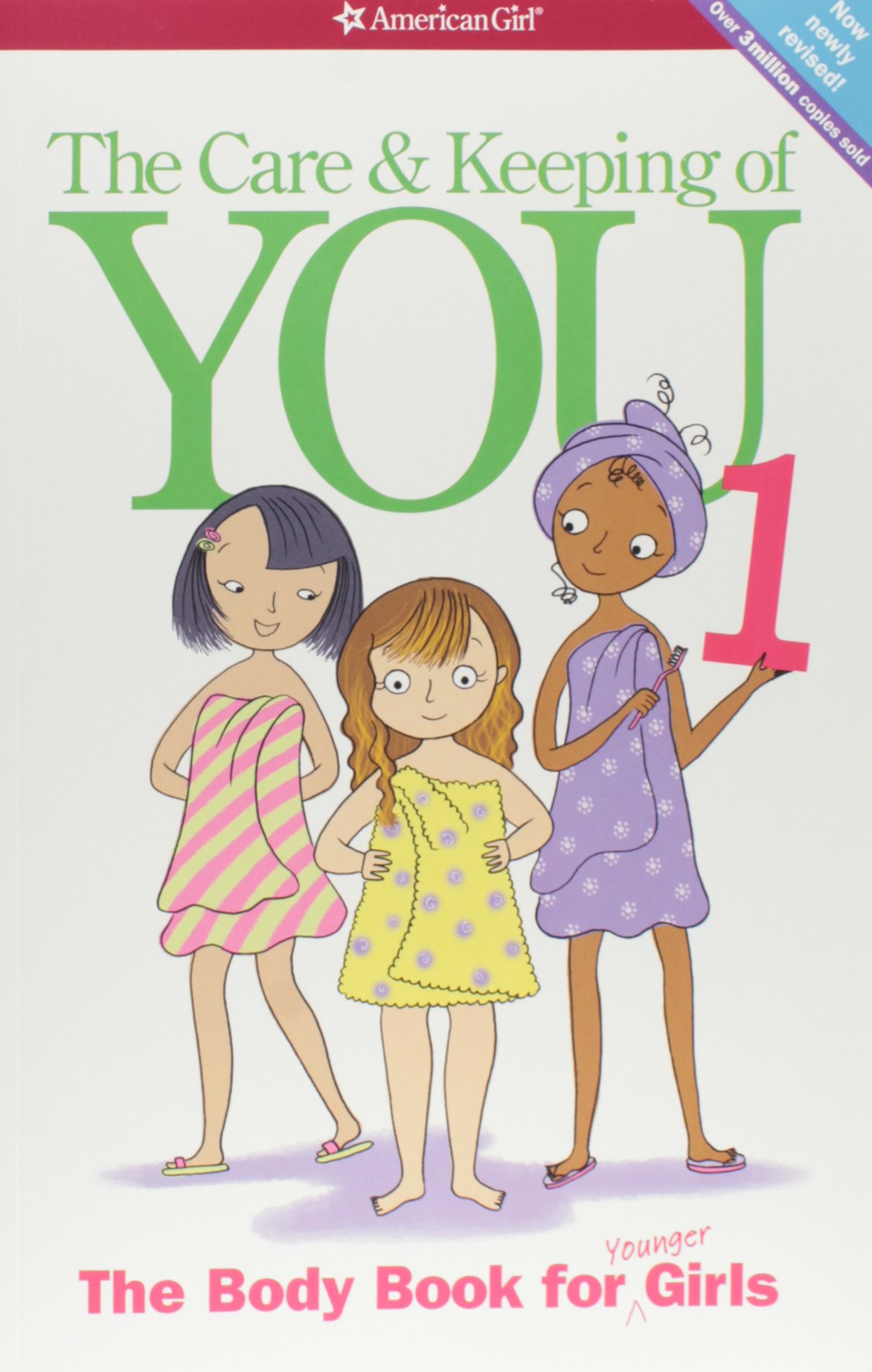
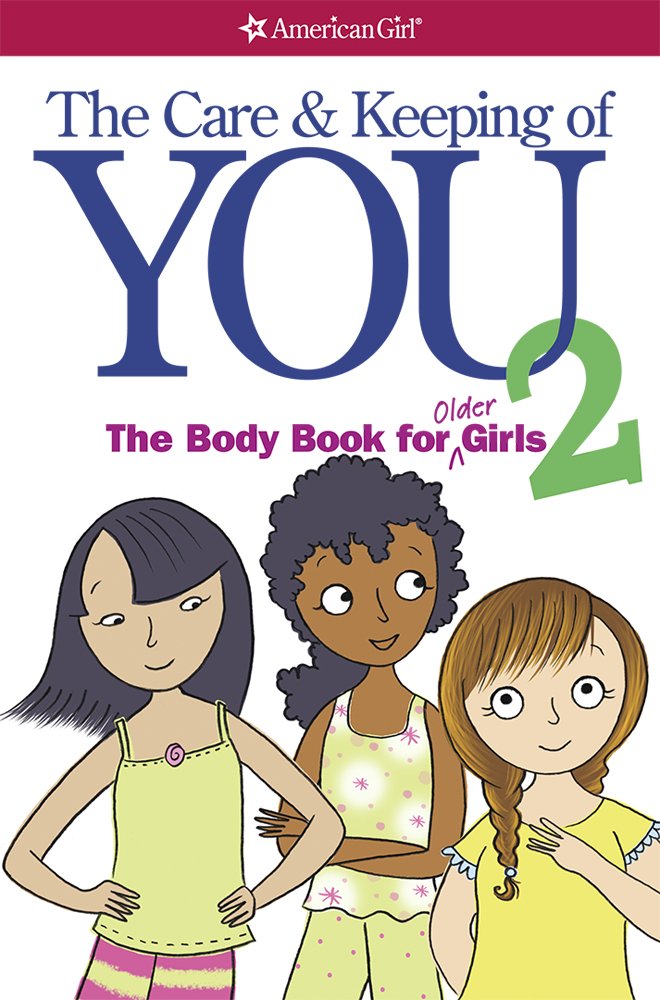
The Care and Keeping of You is another series of books by the same publisher as Guy Stuff – the body book for boys. These books however are directed towards girls and are split in to 2 volumes – one for younger girls and one for older girls.

Image result for the care and keeping of you                             Image result for the care and keeping of you

Author Valorie Lee Schaefer walks girls through the basics of puberty, including how girls’ bodies change, how to choose a bra, and what menstruation is and how to manage it. It also discusses basic self-care from good sleep habits to exercise and nutrition, and discusses issues surrounding body image. Illustrations depict breast development and how to use sanitary pads.(Schaefer, Natterson and Masse, 2012)

Image result for the care and keeping of you

Schaefer wrote the text in a deliberate, reassuring tone, one she called the “trusted, cool aunt.” “It wasn’t your mom or dad’s older sister,” Schaefer says. “It was probably their younger sister, someone with a few years under her belt, but also someone who wasn’t so out of touch with her adolescence that she couldn’t remember what a confusing time that was.” (Pohle, 2019)

 The tone in which the information is delivered to the child is such an important factor in ensuring the attention of the child is present and the text isn’t boring or too complicated for them to understand.  Many books on this topic can have a “clinical” approach which is good in regards to the factual side on things, but not so much for the tone and how it is delivered. The book is described as a good balance between chatty and serious in an approachable way.

After thoroughly researching the books available for parents to help teach their children about Puberty and Sex, It has given me a beneficial insight to how illustrators and authors use the information and artwork in a clever and engaging way. This is something the Let’s Talk app will focus on to achieve the best approach to talking about the many stages involved in growing up. 


References –

Developing a Storyline

When researching storyline development I read an article of the 9 steps to develop an effective storyline for a children’s book. The article was written by Eevi Jones, an award winning and 7 times best-selling children’s books author, it is a very comprehensive article and I have decided to follow the 9 steps she outlines in this post as a way to help us begin to develop an effective storyline for our application (Jones, 2019)

Step 1 – Choose a Format

This step requires you to consider whether you will publish and ebook or a paper book. As we are making an appilcation, our story will exist in a digital space anyways therefore this step doesn’t specifically apply to our project

Step 2 – Write a book for Children, not for Adults

This step is more of an important reminder that although children won’t be the people purchasing the book, it is important that the story is enaging and interesting for them.

Step 3 – Narrow Down your Book Category

CategoryAgeWord CountPagesIllustrations
Picture Book0-3032Every Page
Young Picture Book2-5200-40032Every Page
Trade Picture Book4-8400-80032+Every Page
Picture Story Book6-101,000-3,00032+Every Page
Chapter Book6-103,000-10,00032+Almost Every Page
Middle Grade Book8-1215,000-40,0008212+ Illustrations

(1) Chart describing Book Categories

We are aiming the book towards 8-12 year olds, because this is the age within which children begin to go through puberty. Our story will be in the form of an interative application which means it will rely on both animations and text to convey the storyline. Nonetheless the story will need to be reasonably complex to address all the issues within the topic. Each chapter will address a certain topic and there will be a mini informational story within each chapter.

Step 4 – Really get to know you Target Audience

  1. The Children who will consume your book
  2. The Grown ups who will purchase your book : main buyers are aged 33-40 , 70% female (1)

Spend time with the age group

Talk to parents and teachers

Give a survey to women and men in targeted category

Study Books in your targeted age group

  1. General Layout
  2. Vocabulary Used
  3. Bookstore or Library
  4. Age Group/ Consumer Trends
  5. Census/Demographic Details

Step 5 : Choose a writing Style

  1. Past/Present Tense?
  2. First of Third Person ?

Step 6 : Important Elements to Remember

  1. Unforgettable Characters
  2. Suspense/Action
  3. Realistic Dialogue
  4. Storyline
  5. Instant Recall Factor

Step 7 : Title

Our current working title for the whole project is Let’s Talk. We aim to stick with this title because we think it is appropriate for the message we are trying  to communicate. We wish to approach the topics of puberty and sex in an age appropriate, open and honest way that encourages children to talk about them openly with their parents and friends about sex.

Step 8 : Editor 

Considering there are four of us working on the project I don’t think it will be necessary for us to hire an editor becuase we can always proof read eachothers work and will all be on the look-out for correct spelling and grammer in eachother’s work.

Step 9 : Illustrations

It is recommended in the article that we structure the illustrations horizontally as this is best for a journey like story. This also suits us well as we will be creating for a mobile device such as a tablet it makes more sense usability wise to design for a horizontal screen. We will need to create a storyboard once we have completed the storyline and decide what animations/interactions will be done as part of each story.

Let’s Talk

Some important things to remember when writing the script for Let’s talk is that it must have a balance of being ethically appropriate while being suitable for younger and older children between the ages 8-14. These factor will come into play especially when narrating the storyline. The pitch and tone of the voice must be appealing for the children using the app, keeping them engaged. Some parts of the app may need to have a hint of a lulled tone to ensure a sense of seriousness to the content on screen. 


References


E-Learning App Research

What is eLearning?

eLearning, or electronic learning, is the delivery of learning and training through digital resources. The material is is provided through electronic devices such as computers, tablets and mobile phones that are connected to the internet. (McNamee, P. 2018).

“…traditionally, the internet has been seen as a place where sexual misinformation thrives and harmful sexual paradigms propagate, a new class of educators is trying to change that stigma. By presenting accurate and accessible information combined with the latest advancements in technology, sex education advocates across the country are using eLearning to promote healthy sexual attitudes and pedagogy.” (Heikkela, 2018)

E-Learning opens up a wide range of innovative opportunities which could help to educate children and teenagers to a better knowledge of sexual education. Many children love using technology so it makes sense for a new technological approach to learning is introduced. When a child wants to pick up their tablet and play a game they might decide to jump into an eLearning app too. It’s an easy way to keep them interested and engaged to the learning activities on their screen. The advantages of eLearning is how easily accessible and cost effective it is. You can dive in to the app at any time and pick up where you left off.

Image result for tablet learning

Assure Model

Image result for assure model

ASSURE is an Instructional Design System that focuses more on the learner. The goal is to produce more effective teaching and learning. The Assure Model will help us in creating our App “Let’s Talk” by keeping us focused on the key aspects of a successful E-Learning app. (Kurt, 2015)

  • Analyse Learners – To be able to create a suitable learning strategy you must first understand your learners. To gain a greater understanding of the learners we will analyse the learners characteristics.

The general characteristics of our learners are that they range between the ages 8-14 as these are the average ages that children start to go through puberty. There is no particular level of education or previous knowledge that a learner may have as it is unclear to know how much a child knows on the subject, as everyone is different in that regard. They are comfortable using technology for fun as well as educational purposes. They find apps engaging and are curious about what changes their body is about to go through during puberty.

With regards to entry competencies, this program focuses on children therefore all they will require are basic literary skills that the majority of children in that age group will have as a result of schooling. The learning styles will feature a mixture of Visual, Auditory, and Verbal learning, as well as being interactive to keep the child interested in learning. The motivation the learner (i.e child) holds is to be prepared for the changes about to happen to their bodies such as a first period or pubic hair.

The learners will work through the app at their own pace. It will be suggested that the parent can go through the app with them, there will also be a pdf available for the parent so they know how to talk to them about this sensitive topic.

  • State Objectives – This tells us what the learner will be able to do as a result of the instruction. We can use these objectives to assess the learner’s progress. 

Growing and Changing –

There are a huge number of things the child will learn as a result of having an education in sex and puberty. They will begin to realise that growth and change are part of of growing up and are unique to each individual. E.g physical, social and  intellectual. These changed continue throughout your whole life. Learners will be able to identify emotional changes that have taken place since infancy as a result of hormones. They will also begin to appreciate the need for privacy’s well as recognising how independence and responsibility increases the older they get. 

New Life –

Learners will become aware of new life and birth in the world and develop an awareness of human birth. Learners will be able to discuss the stages and sequence of the development of the human baby from conception to birth. 

Knowledge about my body

Learners will begin to appreciate the need and understand how to care for his/her body, and respect their own body and the body of others. Learners will be able to name parts of male and female bodies using appropriate anatomical terms. Learners will explore and discuss the different things the body can do. Learners will develop and practice basic hygiene skills. Learners will understand the changes taking place in both male and female bodies and realise that these changes do not take place at the same time and that this is natural and normal. Learners will understand the relationship between health and hygiene.

  • Select Media & Materials

Given the stated objectives the next step is to select media suitable to achieve these objectives. We want to take a storyline approach, including animations and interactivity in our app. We decided this was a good idea as the storybook format will allow us to age the character and interest the user, as well as the interactivity including them in their learning as opposed to it being taught at them.

  • Utilize Media & Materials

This step involves planning how to make use of the materials selected in the previous step. This step is comparable to some project management processes. The media will be incorporated into each chapter of the app. The app will use animation and interactivity to thoroughly go through each chapter and engage the user throughout. The animations will also have a voiceover.

Is it selected on the basis of student need?

Yes, we believe the media will be useful to the student because it will not only inform them but engage them in their learning.

Is it appropriate for the teaching format?

We think it is appropriate to include engage the learner to make sure they are grasping the sensitive information.

Is it appropriate for the technical format?

We think it would work well as long as there will be no need for an internet connection once the app is downloaded.

Is it consistent with the students’ capabilities and the instructor’s teaching style?

Both the students capabilities and the teacher’s style would be catered for as the animations will be descriptive.

Does it help to meet the learning outcomes?

Yes because it reinforces the information and gives the learner something to interact with.

  • Require Learner Participation

This plans how to actively engage your students in the material that is being taught. We must ensure that the learners are taking part in the learning process. We will facilitate this by having the chapters laid out in a way that would be easy for learners to follow along with and have a character guiding the interactivity aspect of the app so the user knows how and when to participate.

Feedback will be provided when the user gets through a chapter, for example puberty they will get a badge to signify the completion of the chapter and what they have learned. Material in the form of animations will be utilized to give reinforcement of the information and be a guide to learners.

  • Evaluate & Revise

This includes an evaluation of the teaching strategies and the technology, media, and materials used. A plan how we will evaluate the success of our techniques, media and learners progress will be carried out once the app is created and tested on users.