
From taking the modules ‘Animation Principles’ and ‘Advanced Animation’ I have acquired the fundamental skills to create animated videos for the Let’s Talk app. Having these skills allowed me to take the role as Animator for the scenarios.
What is animation?
“Animation as an art, an approach, an aesthetic and an application informs many aspects of visual culture, from feature-length films to prime-time sitcoms, from television and web cartoons to display functions on a range of new communications technologies” (Wells, 2002)
Improving my animation skills
- Observing people: Look at how people interact with each other and how they express themselves. How do they move can help gain a good understanding of motion but also timing and weight.
- Seek out real world references: Using people to see how they express their emotions through their facial features is key when animating. Looking in a mirror at your own face to create emotion can help when animating a character.
- Film yourself: To understand how and why a character moves is important. Filming yourself is a good idea when trying to figure out how a body would move realistically. Act out scenes and it will show you how you can animate your character.
- Lead with eyes: The eyes move first when deciding where to go and then the head and neck follow. This continues down the body. So the eyes are what we are drawn to first so they should move before the body.
- Study the effects of gravity: Gravity effects everything you want to animate. Keep this in mind when moving a character.
(Redman, 2018)
Basics of animation
Understanding the way people and objects move is a very important skill to have when being an animator. Also developing a good sense of timing is very important to become a good animator. (Maestri, 2006, p.105)
Understanding Motion
A character moves their body for a reason, and these motions are very important because they convey the characters mood and personality to the audience. “Only through motion can the character truly come to life.” (Maestri, 2006, p.105)
Motion is the result of a force acting on an object. The force of gravity pulls objects to the ground but there are other ways that effects the way a character moves which include wind, the weight of the object or the forces exerted by the characters own muscles. The fact that muscles apply force is an important concept. Muscles work the same as gravity as they can cause objects in the case of animation, the characters limbs to accelerate and decelerate. (Maestri, 2006, p.106 p.107)
The Language of Movement
When animating the characters in a realistic way having a good understating of how the human body moves is key. When animating the scenarios for the app keeping the following in mind will become very useful:
Timing: As an animator, by using timing allows you to guide the audiences eyes through the characters actions.
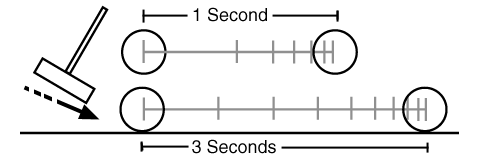
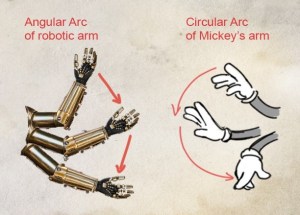
Arcs and Natural Motion: Objects usually move along arcs. This is because objects are usually subject to many different forces. In the case of animation, characters arcs are also created by the natural mechanics of the human body. Joints move by rotation and this creates arcs. Animating joints they use forward kinematics, they move by rotation. These rotations automatically move the characters joints along an arc. This movement gives a natural look to the character.
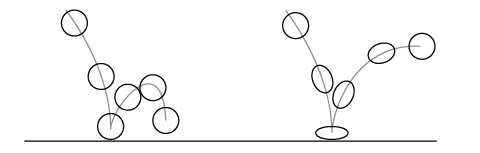
Squash and Stretch: Most objects tend to flex and bend when they move. Because objects can change shape when forces are applied these idea is helpful when animating. For character animation there are levels of squash and stretch. With a realistic character the effect of squash and stretch can be less dramatic. But in a more cartoony environment the squash and stretch can be more rubbery.
Anticipation: It is the body’s natural way of gaining momentum before an action takes place. In animation by exaggerating it, we can keep the viewers attention and achieve better timing.
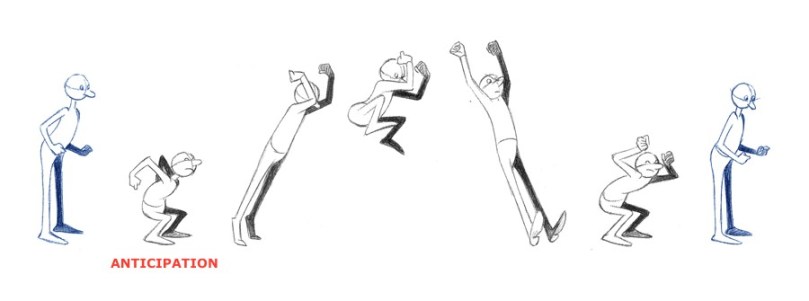
(Maestri, 2006, p.117 p.118 p.123 p.127)
For Let’s Talk the majority of the character animations will be created by using Adobes Character Animate. Using this software makes it easier to animate facial expressions as it live motion capture of your own face through a webcam. This allows me to give a better performance to convey the correct emotion that I am trying to emulate. “Facial expressions convey a lot of emotion and it’s very important to understand these expressions and the way the face communicates emotion.” (Maestri, 2006, p.196) Before animating a face I practice the facial expression I want by using a mirror this gives me a better understanding of how to show this emotion correctly through the character.
Animation videos that we helpful when animating were the youtube channels ‘Jaiden Animations’ (Dittfach, 2019) and ‘Murrz’ (Murrz, 2019). Taking inspirations from their videos for ‘Lets Talk’ animated scenarios.
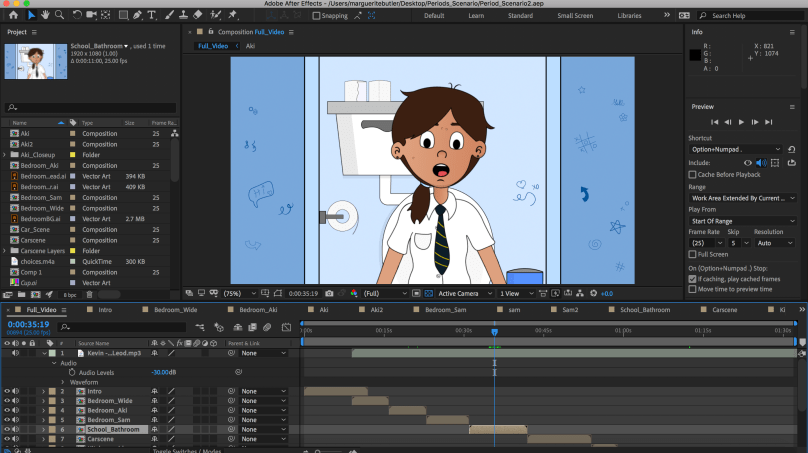
For animating backgrounds and composting the animations I used Adobe After Effects. I find using a combination of both soft wears gives the best result for my skillset.
References
Dittfach, J. (2019). Jaiden Animations. [online] YouTube. Available at: https://www.youtube.com/channel/UCGwu0nbY2wSkW8N-cghnLpA [Accessed 27 Mar. 2019].
Maestri, G. (2006). Digital character animation 3. Berkeley, Calif.: New Riders, p.105, p.117, p.118 p.123 p.127 p.196
Murrz (2019). Puberty. [image] Available at: https://www.youtube.com/watch?v=ZZ4CzW_aEBQ [Accessed 5 Apr. 2019].
Redman, R. (2018). 15 ways to improve your character animation. [Blog] Creative Bloq. Available at: https://www.creativebloq.com/audiovisual/improve-character-animation-41411447 [Accessed 20 Mar. 2019].
Wells, P. (2002). Animation: Genre and Authorship. London: Wallflower, p.1. [Accessed 23 Mar. 2019]
 Let's Talk - Project Blog